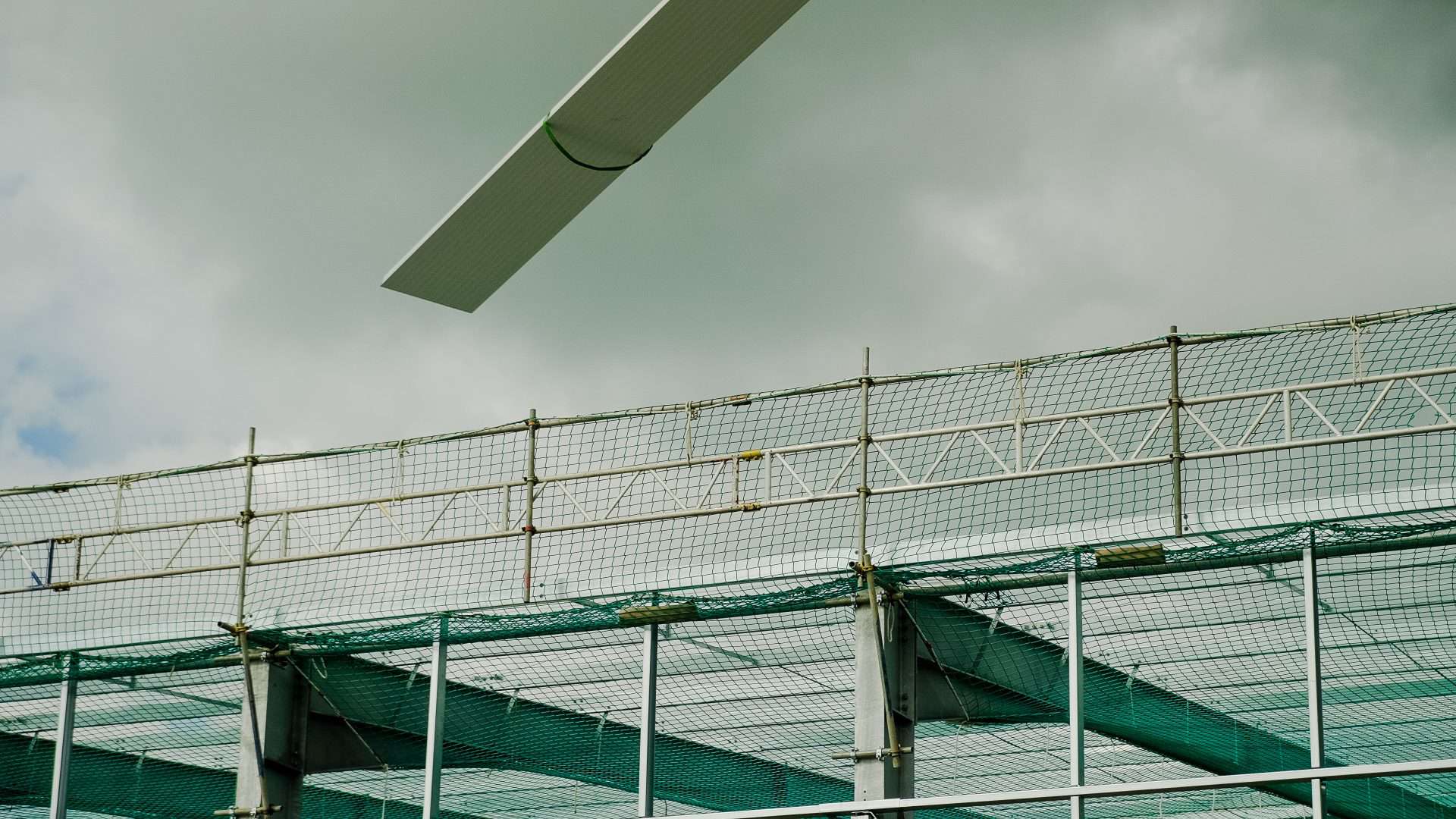
Fall protection during initial construction of housing schemes is well understood. Netting during the roofing phase. Scaffold edge protection during envelope work. Documented handover once the build is complete. What is less well understood, and often not planned for at all, is fall protection for the maintenance access that will be required across the following decades of the building’s life.
Every roof will need maintenance at some point. Tile replacement after storm damage. Chimney work. Aerial or satellite dish installation. Solar panel maintenance. Gutter clearance. Each requires roof access, and each requires appropriate fall protection for the operative doing the work. Where no permanent fall protection has been designed into the roof, temporary provisions have to be brought in each time, at significant cost per visit.
The mismatch between initial construction planning and future maintenance needs is one of the more common oversights on housing schemes. Developers and their design teams focus on the initial build. Building occupation begins. The eventual maintenance responsibility passes to the homeowner or the housing manager. By that point, the cost of establishing safe roof access falls on parties who were not involved in the original design decisions.
Permanent fall protection systems designed into new build housing include roof-mounted anchor points, roof-integrated walkways, roof edge protection on flat sections, and roof access ladders where appropriate. Each has its own specification requirements under BS EN 795 and related standards. Each carries a cost at initial installation that is significantly lower than the cost of retrofitting later.
Red Safety Netting’s specification service for housing schemes includes advice on permanent fall protection provisions where the developer or their consultants want to consider them. The choice is not always to install permanent systems. For low-rise residential housing, the maintenance requirement can often be met by temporary provisions brought in as needed. For multi-storey residential blocks with regular scheduled maintenance access, permanent systems typically pay back within a few years.
For housing associations and social housing providers managing large stock, the fall protection question is significant. Each property in the stock will need periodic roof access. Where each access uses temporary provisions procured separately, the cumulative cost is substantial. Where permanent systems are designed in, either at new build stage or during major refurbishment, the ongoing cost falls materially.
Red Safety Netting’s engagement with housing associations includes fall protection audits of existing stock, identification of properties where permanent systems would produce cost savings, and design and installation of the systems as part of the association’s planned maintenance programme. The economics favour permanent systems on the majority of multi-storey stock.
There is also a competence question worth flagging. Roof maintenance operatives visiting completed properties are typically not the same competence class as construction operatives. Housing officers, gutter cleaning contractors, aerial installers, general maintenance staff. Each may need to access the roof, and each will have varying training and equipment. A permanent system that any competent person can use safely is a different proposition to a system that requires specialist training and equipment.
The design of permanent systems for housing stock therefore has to reflect the actual users, not just the specialist industrial user base for whom many products are designed. Systems with clear signage, straightforward attachment, obvious hazard information, and standard equipment compatibility work well. Systems that require specialist training and equipment work poorly because they will be used incorrectly or bypassed.
For developers and QSs specifying new build housing, the fall protection question for the building’s operational life is one of the small design decisions that produces significant long-term cost differences. It is not usually a large piece of work to address. It is usually just a piece of work that has to be initiated at the right time.
Talk to Red Safety Netting To discuss fall protection for ongoing roof maintenance work on your scheme, contact Red Safety Netting on 01223 890727 or email enquiries@theglobegroup.co.uk.