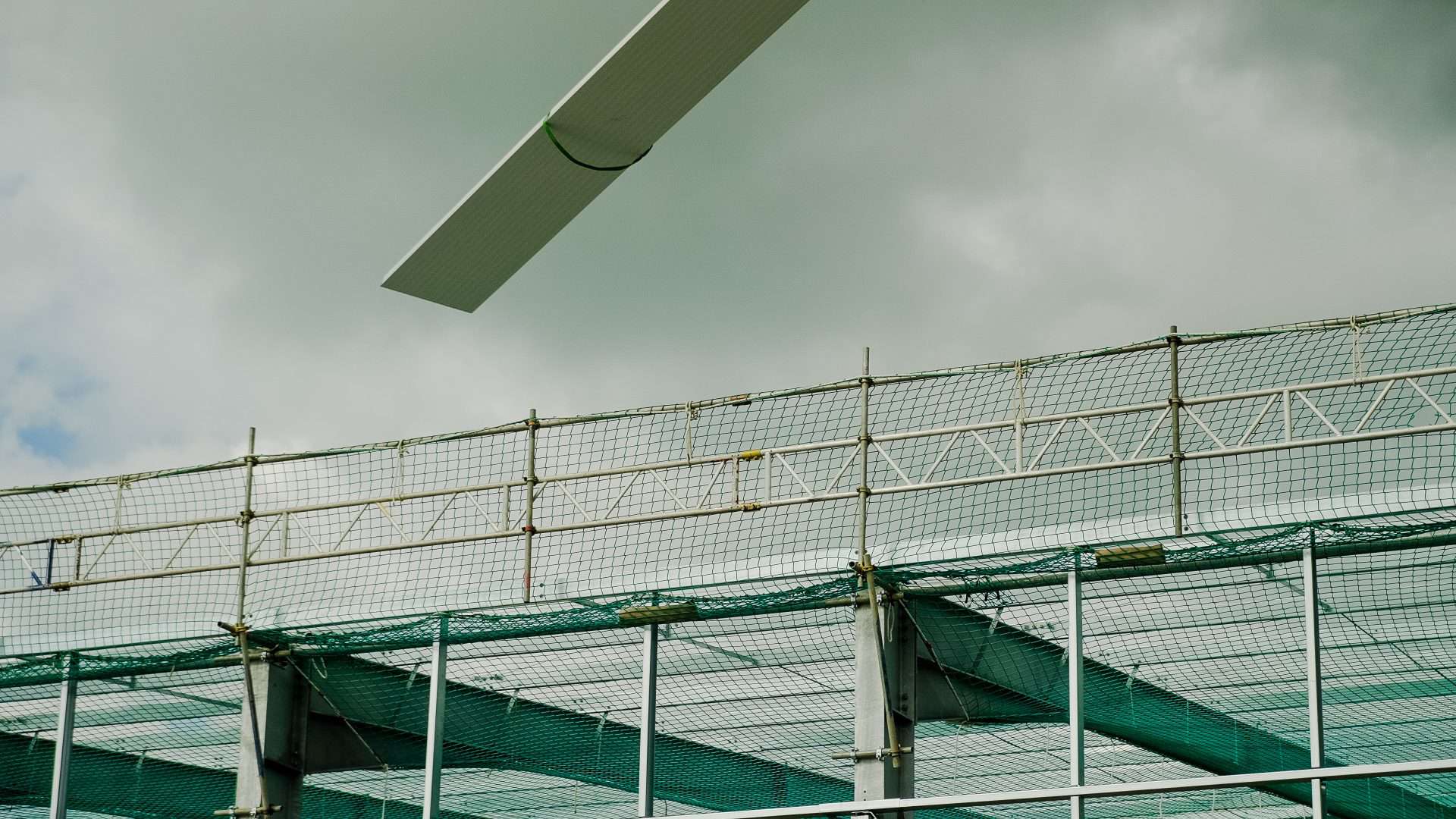
Catch netting installations on UK construction sites are typically configured in one of two ways: inset netting, where the net is set within the scaffold structure beneath the working platform, or bay netting, where the net spans between scaffold lifts or building elements at defined bay positions. Both configurations are valid under BS EN 1263-2. They suit different working conditions, and the choice between them affects installation cost, programme, and the geometry of the working space they protect.
Inset netting is most often used on roofing works where the net sits immediately beneath the roof structure and catches anything that falls from the working area. The clearance requirement is smaller because the catch height is shorter. The installation tends to follow the contour of the roof, with multiple smaller nets covering the full surface rather than fewer larger ones. Inspection access is straightforward because the nets are at scaffold level.
Bay netting is used where the working platform is set above the catch zone with a clearance that accommodates a larger fall energy absorption. This is common on multi-storey commercial work, on industrial buildings with large structural bays, and on residential developments where the roof work involves more complex geometry. The net is fewer-larger units, often suspended between scaffold or structural anchor points across a defined bay width.
The choice between configurations depends on three factors: the actual fall height from the working zone, the clearance available beneath the catch zone, and the geometry of the structure being worked on. None of these is a design preference. Each is a structural and safety calculation.
Fall height affects the net’s required energy absorption. A net catching a fall from two metres absorbs less energy than the same net catching a fall from five metres. Net classification under BS EN 1263-1 specifies the energy classes the net is certified for. Where the actual fall height exceeds the net’s classification, the configuration is not safe regardless of how it looks.
Clearance affects whether the net can perform without striking the structure beneath. A net that catches a fall must deflect under the load. The deflection requires unobstructed space beneath the net. Where the space is not available, the net’s performance is compromised. Bay netting tends to require more clearance than inset netting because the fall energy is higher.
Geometry affects which configuration is practical to install. A simple rectangular roof works well with either approach. A complex roof with multiple ridges, valleys and dormers may require inset netting because the bay approach cannot conform to the geometry. A large open structural bay with predictable working zones may favour bay netting because the spans are clean.
Red Safety Netting’s pre-construction design process establishes the right configuration for each scheme based on these factors, with the calculation documented as part of the design package. The configuration is not a default. It is the engineering answer to the specific conditions of the scheme.
There is also an operational consideration. Inset netting is faster to install on simple geometries but slower on complex ones. Bay netting is slower to install per net but covers more area per net once installed. The installation cost per protected square metre varies between configurations. Where the structure suits both, the configuration choice can be made on cost grounds. Where the structure favours one over the other, the choice is structural rather than commercial.
For principal contractors and developers evaluating fall protection tenders, the question worth raising is what configuration the contractor proposes and what the engineering basis for that choice is. A contractor whose answer is generic, with the same configuration applied to every scheme regardless of conditions, has not engaged with the engineering. A contractor whose answer reflects the actual structure and the actual fall conditions has.
The cost difference between properly specified and badly specified configurations is small. The safety difference can be significant. The CDM file evidence trail also looks substantively different between the two cases. For schemes where fall protection carries genuine duty, the configuration decision is worth taking seriously rather than leaving to a default.
Talk to Red Safety Netting To discuss inset and bay netting configurations on your scheme on your scheme, contact Red Safety Netting on 01223 890727 or email enquiries@theglobegroup.co.uk.