Fall arrest and fall restraint are both approaches to managing the risk of falls from height, and both appear regularly in fall protection plans and method statements on construction sites. They’re not interchangeable. They address the fall risk in fundamentally different ways, they have different performance requirements, and specifying one when the other is appropriate is a safety failure — regardless of whether either system is present on site.
For principal contractors and site managers responsible for fall protection on construction sites, understanding the practical difference between fall arrest and fall restraint — and the circumstances in which each is appropriate — is essential context for evaluating whether the fall protection plan for a project is genuinely adequate.
What Fall Restraint Does
Fall restraint prevents a person from reaching a position from which a fall could occur. A restraint system — typically a harness connected by a lanyard to an anchor point — is configured so that the lanyard length prevents the wearer from reaching the unprotected edge. If the system is correctly configured and the wearer stays connected to the anchor point, they physically cannot fall from height because they cannot reach the fall hazard.
The critical dependency in a restraint system is correct configuration. The lanyard length must be set so that the wearer cannot reach the unprotected edge — which means the anchor point position relative to the edge needs to be assessed and the lanyard length specified accordingly for each working position. A restraint system with a lanyard that’s too long doesn’t restrain — it allows the wearer to reach the edge and potentially fall, while giving both the wearer and the principal contractor false confidence that fall protection is in place.
Restraint is appropriate where the work activity allows the operative to remain at a defined distance from the fall hazard throughout the task — maintenance work on a flat roof, for example, where the anchor point can be positioned to keep the operative away from the perimeter edge. It’s not appropriate where the work requires the operative to work at or near the fall hazard — roofing work on a pitched roof, where the operative needs to work across the full surface of the roof including at the eaves.
What Fall Arrest Does
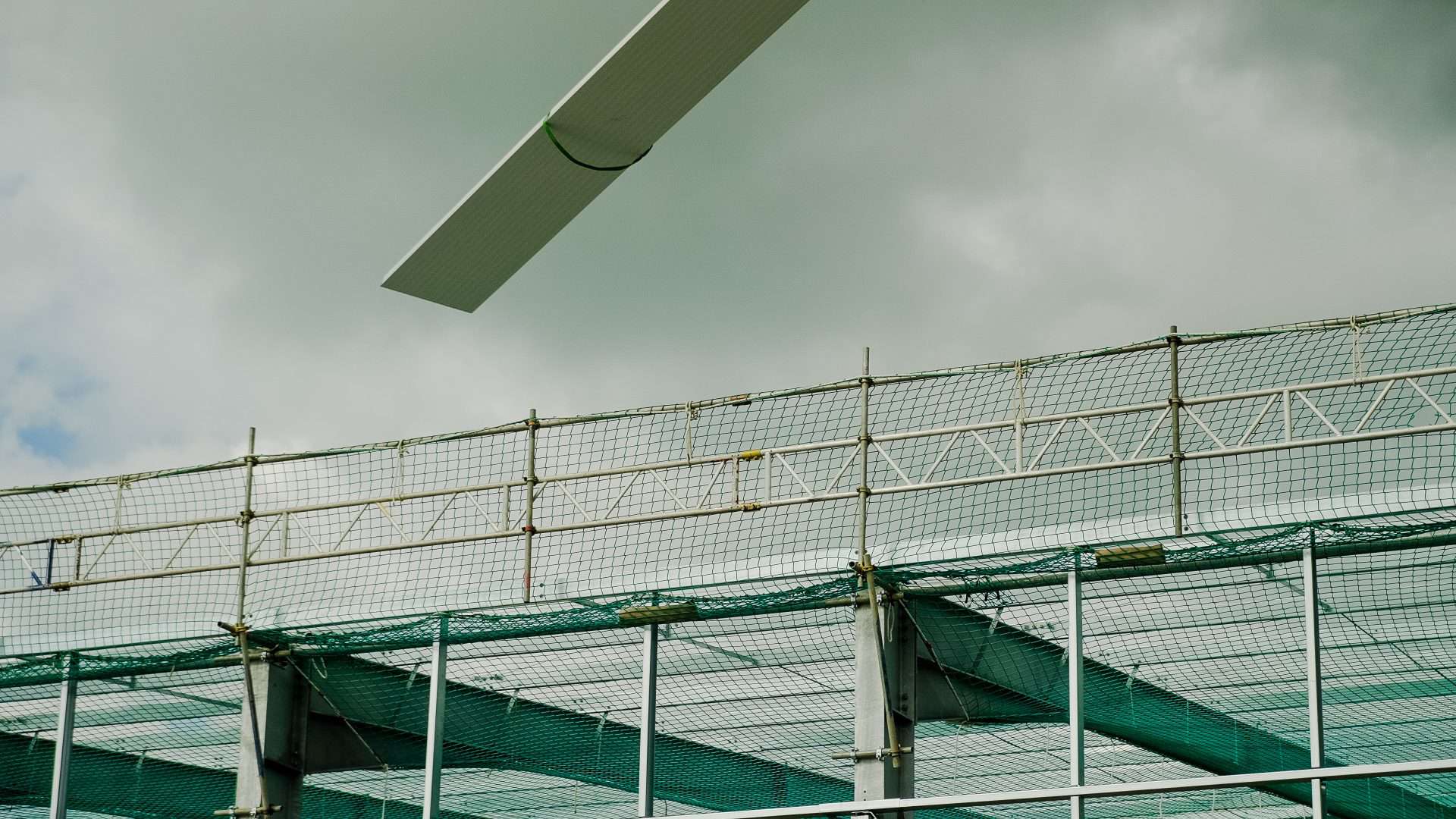
Fall arrest doesn’t prevent a fall — it arrests it. A fall arrest system allows a fall to begin but stops it within a defined distance, limiting the forces applied to the person falling and preventing them from striking the structure or ground below. Safety netting is a collective fall arrest system — it arrests falls across a protected area without requiring individual operatives to be connected to personal equipment. Personal fall arrest systems — harness, energy-absorbing lanyard, and anchor point — arrest an individual’s fall after it has begun.
The key performance requirement for a fall arrest system is clearance — the distance between the system and the structure or ground below needs to be sufficient to allow the system to arrest the fall before the falling person strikes anything. For safety netting, that clearance requirement is defined by BS EN 1263-1, which specifies the net classification, anchorage requirements, and clearance geometry for different installation configurations. For personal fall arrest systems, the clearance requirement is determined by the fall distance before the lanyard engages plus the deceleration distance during arrest — which can be several metres in total.
Specifying a personal fall arrest system where the clearance beneath the working position isn’t sufficient to arrest the fall before the person strikes the structure below is a specification error that provides no protection in practice — the fall arrest system engages, but too late.
Choosing the Right System for the Work Activity
The choice between fall arrest and fall restraint — and between collective systems such as safety netting and personal systems such as harnesses — should be determined by the nature of the work activity and the fall hazard, not by what’s most convenient to install or most familiar to the contractor.
For roofing work on pitched roofs, collective fall arrest — safety netting installed beneath the roof structure — is typically the most appropriate primary protective measure. It protects every operative on the roof without depending on individual compliance, covers the full roof area including positions where personal restraint systems would prevent the operative from doing the work, and continues to provide protection if an operative loses their footing unexpectedly at any point during the working day.
Red Safety Netting’s fall protection assessments consider the specific work activity, the fall hazard geometry, and the clearance available — specifying the system that provides genuine protection for the people doing the work, not the system that’s easiest to install. That assessment is documented and provided to the principal contractor as part of the installation record, giving them the evidence that the fall protection specified is appropriate for the risk.