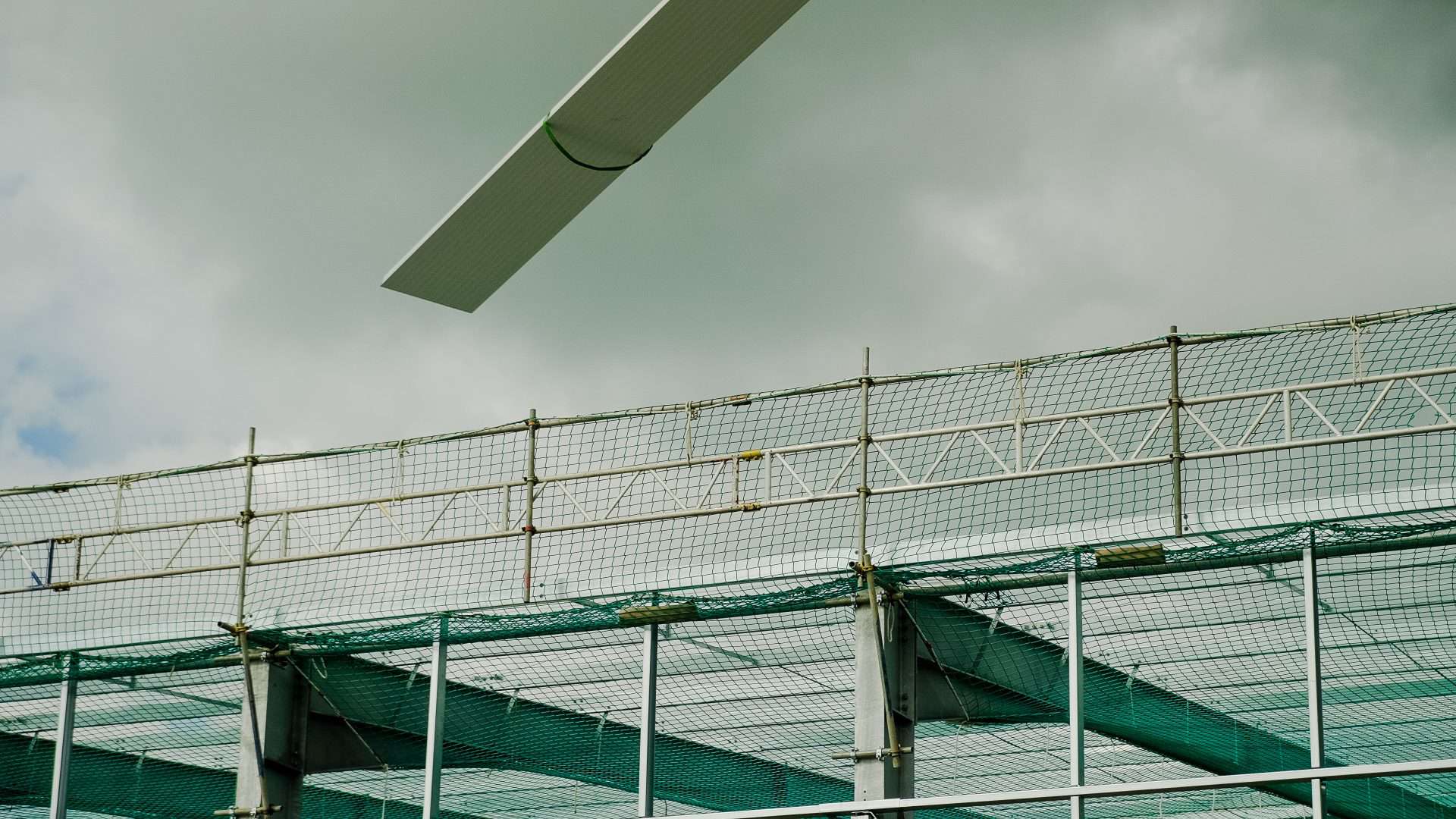
On a new build residential development, safety netting and roofing are not independent activities. They’re interdependent — the netting needs to be in place before roofing work begins at each plot, maintained throughout the roofing programme, and decommissioned in a sequence that doesn’t leave plots unprotected while roofing work is still progressing nearby. Getting that relationship right is one of the most important coordination tasks on the roofing phase of a residential development.
When safety netting and roofing are procured from separate, unrelated contractors with no established working relationship, that coordination sits entirely with the principal contractor — who has to manage the sequencing between two businesses that have no particular incentive to accommodate each other’s programme requirements. When Red Safety Netting and Globe Roofing are working together on the same development, that coordination happens within the Globe Group, with the netting installation programme planned around the roofing programme from the outset.
Why the Sequencing Matters
The sequencing of safety netting installation relative to the roofing programme is more operationally sensitive than it might appear. Netting installed too early — before the scaffold configuration is finalised for the roofing phase — may need to be repositioned when the scaffold is adapted, adding cost and creating a gap in protection during the repositioning. Netting installed too late — after the roofing gang has already started work on the plot — means there was a period of unprotected work at height that shouldn’t have occurred.
On a multi-plot development with roofing progressing across several plots simultaneously, that sequencing challenge is multiplied. Each plot needs netting in place before roofing starts. Each plot’s netting needs to remain in place and undisturbed throughout the roofing programme on that plot. And the decommissioning of netting on completed plots needs to be managed so that it doesn’t affect protection on adjacent plots where roofing is still progressing.
Red Safety Netting plans the installation programme on multi-plot developments against the roofing programme — plot by plot, tracking the roofing progress and ensuring that netting is installed, maintained, and decommissioned in a sequence that maintains continuous protection throughout.
What FASET Accreditation Means for the Roofing Contractor
For the roofing contractor working on a development where Red Safety Netting has installed the safety netting, FASET accreditation provides assurance that the netting has been installed correctly — that the anchorage points are appropriate, that the net classification matches the fall energy that needs to be arrested, and that the clearance geometry beneath the net is sufficient to prevent a falling person from striking the structure below.
That assurance matters because the roofing gang’s safety depends on the netting performing correctly if a fall occurs. A net that hasn’t been installed to the correct standard — inadequate anchorage, insufficient clearance, incorrect net classification — may not arrest a fall within the distance available. FASET accreditation, and the installation documentation that accompanies it, provides the evidence that the netting meets the standard required.
For the principal contractor, FASET-accredited installation documentation also provides the CDM compliance evidence that the fall protection provided for the roofing programme was specified and installed by a competent contractor — not just that netting was present on site.
Managing Netting Around Scaffold Adaptation
On a residential development where the scaffold is being adapted as the construction programme progresses — additional lifts added as the structure rises, configuration adjusted for the roofing phase, sections decommissioned as plots are completed — the safety netting installation needs to be managed in coordination with those adaptations.
Where Globe Cambridge is providing the scaffold package on a development where Red Safety Netting is providing fall protection, that coordination happens within the Globe Group. Scaffold adaptations that affect the netting installation are communicated between the two divisions before the adaptation takes place, so that the netting is repositioned or temporarily removed and reinstated in a controlled sequence — maintaining protection throughout rather than creating unplanned gaps in cover.